
Our Projects
Research and related undertakings
Gender analysis of boards of Canadian Muslim charitable institutions
A few years ago, one of our founders approached her local mosque, which was soliciting donations for a massive expansion project.
She asked if women would be included on the board of the new, larger mosque. The answer was a resounding ‘no’. And so she decided to donate to another mosque that was more inclusive of women.
A few years later, she came across a similar situation in British Columbia, where the British Columbia Muslim Association (BCMA)—the oldest Muslim charity in Canada—had stipulated in its by-laws, for 50 years, that only men could become directors; only men could vote for the directors, and only a man could be president.
Research of the public records of the BCMA and the local mosque, on the Canada Revenue Agency (CRA) website, confirmed the presence of an all-male board of directors for five consecutive years for each organization. Were there others that did not include women in shaping the governance and direction of an important community institution?
The project
And thus began the Gender Board analysis project in 2020 – an attempt to look at the gender make-up of Muslim charitable institutions registered with the CRA. The initial study was completed in 2022 by University of BC student researcher and Loran Scholar Lavan Balandran. The current study, completed in 2024, includes the gender composition of the boards of over 500 organizations from 2014 to 2022.
The analyzed data tracks the ratio of women to men, on boards by province and city. This data is updated every year based on tax return information available on the CRA website.
The community
We know that countless individuals – women and men – have volunteered their valuable time to build Muslim community institutions across Canada. In some cases, their governing bodies reflect the diversity of the congregation; in some cases, they do not. A nascent community can only thrive by including the voices of all its members. Like all communities, Muslims can do better. And they strive to do so. Just look how far they have come.
We hope this study allows Muslim institutions to reflect whether or not women have a seat at the table. We understand that while women may be active in committees, they are not part of the decision-making process. Sometimes, women themselves are reluctant to come forward due to time constraints, cultural attitudes, and the like. However, if our institutions are to be vibrant, welcoming, and inclusive, we must strive to include the voices of women at the board level – to shape governance and policies that reflect the entire community.
Our goal is to encourage Muslim communities to reflect upon their institutions, and strive to be more inclusive of women at the board level. Community members can use this information to see which of their institutions are making an effort to include women, and which institutions are not.
Change can happen – when congregants demand it. The local mosque (mentioned above) and the BCMA now have women on their boards, thanks to the hard work of women and men, alike.
The research analysis
We offer the information in two formats:
- A summary of national, provincial and municipal trends; and
- A searchable database of charitable Muslim institutions for the most recent tax year.
We hope this information will be used by:
- academics for research
- other faith-based communities as a model to research their own institutions
- Muslim community members
Our goal is to encourage Muslim communities to reflect upon their institutions, and strive to be more inclusive of women at the board level. Community members can use this information to see which institutions are making an effort to include women in the governing process.
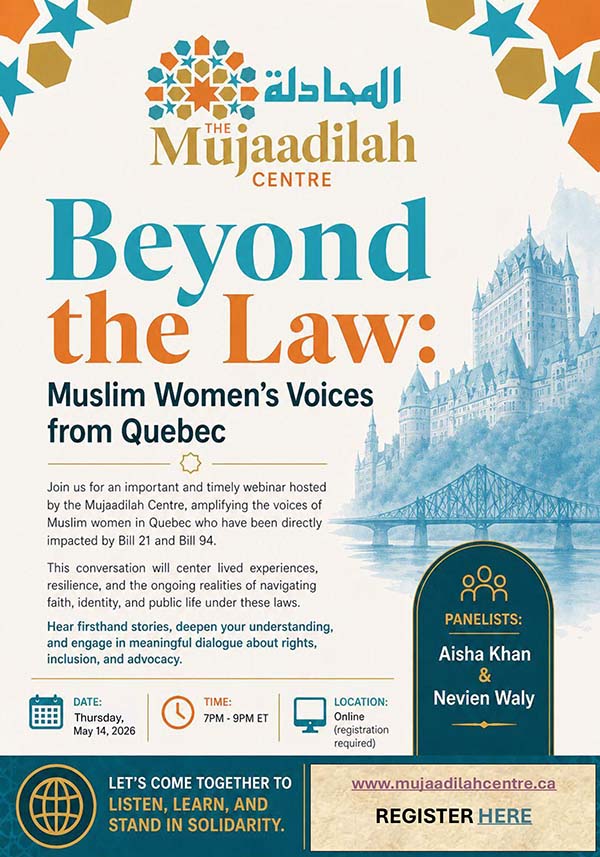
Beyond the Law: Muslim Women’s Voices from Quebec
Join us for an important and timely webinar hosted by the Mujaadilah Centre, amplifying the voices of Muslim women in Quebec who have been directly impacted by Bill 21 and Bill 94.
This conversation will center lived experiences, resilience, and the ongoing realities of navigating faith, identity, and public life under these laws. Hear firsthand stories, deepen your understanding, and engage in meaningful dialogue about rights, inclusion, and advocacy.
Date: Thursday, May 14, 2026
Time: 7 PM – 9 PM ET
Online (registration required)
Panelists: Aisha Khan & Nevien Waly
Let’s come together to listen, learn, and stand in solidarity.
Read a related Globe and Mail article by Aisha Khan
Reproduced by permission of the author
Quebec’s Bill 94 overwhelmingly affects Muslim women like me
Aisha Khan
Contributed to The Globe and Mail
Published March 31, 2026
Aisha Khan is an occupational therapist based in Quebec.
I’m a Quebecker. I’m an occupational therapist. But above all, I am a wife and a mother of two.
I was born in Quebec. It is where I built my life and where I am raising my family. It is also where I studied and chose a profession that reflects my deepest values. As an occupational therapist, I dedicate my work to helping those who need it most. My profession allows me to help individuals regain their independence after hardship, to help them rebuild physically and cognitively. I use my skills to make a real, tangible impact in people’s lives.
A busy schedule has never kept me from helping others outside of my work. That’s why, a few years ago, I started volunteering at my children’s school. I helped with bake sales, organized movie nights, and prepared and distributed food to staff on special occasions. At first, I did this simply to be present for my children. They loved seeing their mother at school. They loved it when their friends ran up to me excitedly to say hello, and when their teachers shared their appreciation.
Very quickly, I saw the difference I could make for other children, not just my own. I saw the difference that a little support could have on the hardworking staff who dedicate so much of themselves on a daily basis. Volunteering became part of who I am. It’s how I give back and how I help build the future generation of our country.
Now, I’m being told because I’m a Muslim who wears a headscarf, I’m no longer welcome. I’m being told that the way I dress is a problem. That the rules have changed for women like me. That my volunteer work is no longer acceptable unless I change how I look.
Under Quebec’s Bill 94, adopted by the Coalition Avenir Quebec government in October, 2025, mothers who wear a headscarf are prevented from volunteering in our children’s schools. Unless we remove it, we are excluded from being valuable members of our community by helping in classrooms and at school events. Under this law, my headscarf – which has never interfered with my work, my integrity, or my commitment – is suddenly being treated as something children need protection from.
As a health-care professional, my faith has never interfered with my practice. I’ve always been judged on my competence and my ethics, never my appearance. But today, the Quebec government sees it differently. I’ve tried to understand how removing dedicated, well-intentioned volunteers makes our public education system stronger. I still cannot understand it. Because there’s nothing to understand.
When I learned that I could no longer volunteer at my children’s school, I felt deeply hurt. I felt rejected for who I am. I felt my dignity and my integrity being questioned. To have your willingness to help turned into something unwelcome – by the very government that is supposed to represent and protect you – is profoundly painful. The impact on our children is even greater. Laws like this plant the seeds of prejudice and discrimination, teaching them that, in fact, we are not all treated as equals.
I worry about what comes next.
If I can be barred from volunteering at my own children’s school, what guarantees do I have that tomorrow my profession won’t be questioned too? When I see women whose dreams of becoming teachers, lawyers, or educators have been shut down by legislation, I have to ask: Where does this end?
Let me be clear: Secularism is an important value for us in Quebec, and I support it. We do not send our children to public school to receive religious instruction. But preventing mothers from volunteering at their children’s schools – that is not secularism; it is outright exclusion. Creating this fear that children might be threatened by a mother simply practising her religion is both illogical and harmful – and it sows division instead of fostering cohesion.
Related Resources
What is Bill 21?
Canadian Civil Liberties Association
https://ccla.org/wp-content/uploads/2026/03/Fact-Sheet-English-1.pdf
What is Bill 21 and Why Challenge It?
https://youtu.be/0NtRnh_q3Pg?si=IKltNliZoYTPPldE
The Notwithstanding Clause
What the Heck is the Notwithstanding Clause? (by BC Civil Liberties Association)
https://youtu.be/myziX6urDzY?si=o3ll2sVDlw3GYAqn
Notwithstanding Clause Explainer Video
https://www.tvo.org/video/what-is-the-notwithstanding-clause-0
The Problem with the Notwithstanding Clause
https://www.youtube.com/watch?v=ECPFDrDshcM
Is Bill 21 Really About Secularism?
https://youtu.be/0Ehm8geftOA?si=zBkDTdlt85KqSf4c
What is the Notwithstanding Clause?
https://www.youtube.com/watch?v=zZ55FMYY-1g
Understanding the Notwithstanding Clause
https://www.tiktok.com/@cbcnews/video/7577891931129171218
What is Bill 94?
School volunteers speak out against Quebec after filling ‘gaps that you created’
https://montreal.citynews.ca/2026/04/07/bill-94-volunteers-secularism/
UPROAR – Film on Bill 21
https://youtu.be/PzPsls5Ynjw?si=B7XQAazi4W2OcA7z
Sikh Teacher Moves to B.C. Over Quebec’s Religious Symbols Ban
https://www.youtube.com/watch?v=4HDJ2mbZsSE
Quebec School Volunteers Say Bill 94 Affects “All of Us’ in Education
https://youtu.be/PE-Tmh9YwHY?si=yUGmKWemuvE26kUO
School Volunteers say Quebec Secularism Bill 94 Shuts them Out
https://youtu.be/M62NqR1CJ6Y?si=IL7C6Udl6azpcKfn
Former Educator Calls Quebec’s Expanded Religious Symbols Ban in Schools Hurtful (Bill 94)
https://youtu.be/qqAQsTGf4bw?si=f1mXJjqB799C93uw
“I felt the injustice’: Quebec School Monitors Wearing Hijab Lose Job Over Bill 94
https://youtu.be/urcZnCopNAc?si=TvtsbCaLaJhV3GHY
Calls To Action
What Can I Do to Oppose Bill 21?
https://www.youtube.com/watch?v=NygFAntcjys&list=PL2L2n4-GQqZZW8sFeUUlyPbYJFSBW-0_d&index=4
National Council of Canadian Muslims
https://nccm.ca/bill-21/